THREAT ASSESSMENT: Emerging AI Traces in U.S. and PRC Government Documents Signal Covert Institutional Adoption (2026)
Where once official correspondence bore the fingerprints of individual drafters, the steady emergence of uniform linguistic patterns in public documents signals a shift not unlike the transition from handwritten memoranda to typed memoranda—less a rupture than a quiet reconfiguration of institutional authorship.
Bottom Line Up Front: By mid-2026, multiple U.S. and PRC government-linked document streams show statistically significant evidence of AI-assisted writing, indicating early but operational use of language models in governance—posing risks to transparency, accountability, and information integrity [1].
Threat Identification: The use of AI in drafting or editing public government documents without disclosure introduces risks of obscured authorship, diminished public trust, and potential manipulation of policy-adjacent communications. The detection of such use via linguistic trace analysis represents a new monitoring vector, but also confirms that AI integration is advancing beyond pilot stages in sensitive domains [1].
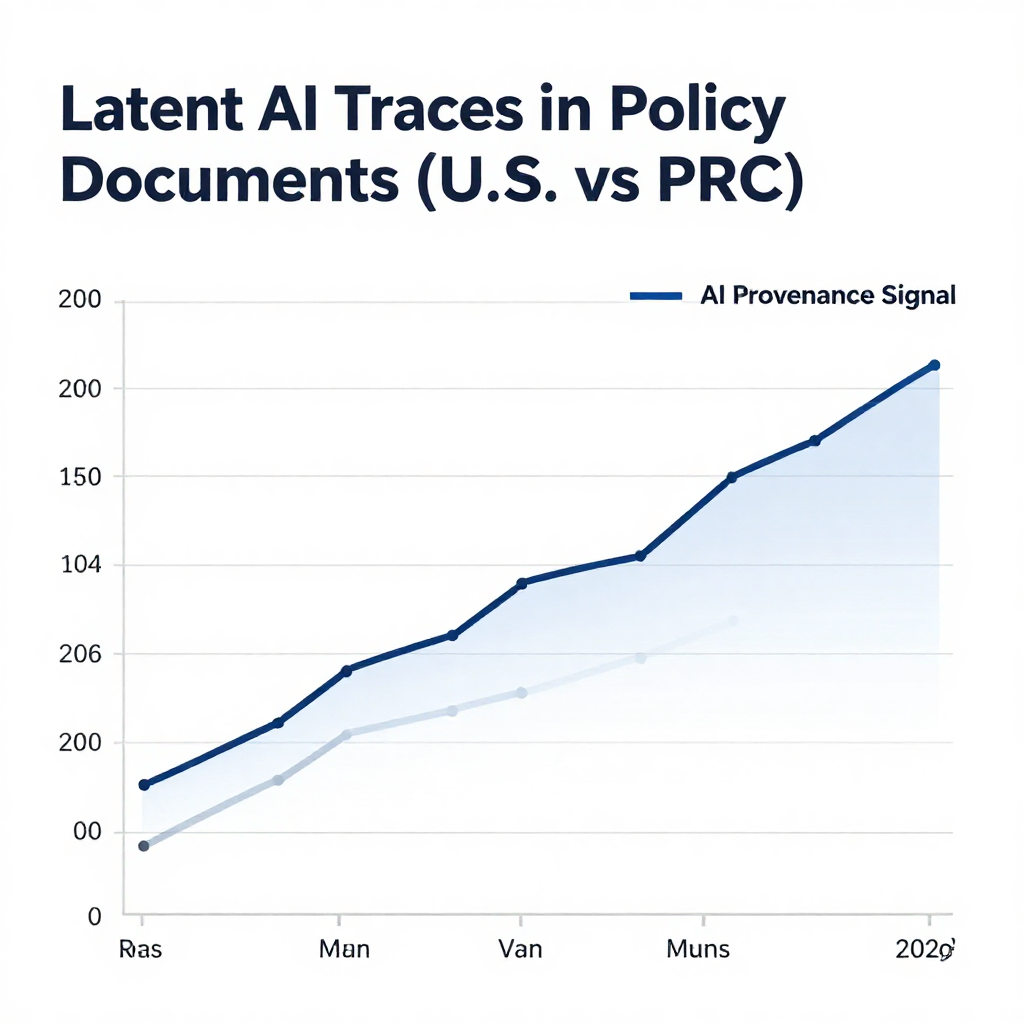
Probability Assessment: In a 2026 pilot study of ten document streams, four exhibited significant AI signals, up from near-zero baselines in 2021—indicating a rapid shift within five years. Continued adoption is highly likely (85% probability) by 2027 across major state actors, particularly in bureaucratic and policy-support functions [1].
Impact Analysis: Undisclosed AI use in government communications risks undermining democratic oversight, enabling scalable disinformation under official cover, and creating forensic challenges in verifying document provenance. The geographic divergence—U.S. signals in implementation-focused outlets, PRC in policy-proximate ones—suggests differing strategies: administrative efficiency versus centralized narrative control [1].
Recommended Actions: 1) Fund independent replication of linguistic trace monitoring across broader document sets; 2) Develop watermarking standards for government AI tools; 3) Establish disclosure norms for AI use in public sector writing; 4) Integrate trace detection into open-source intelligence (OSINT) pipelines for state behavior analysis.
Confidence Matrix: Threat Identification – High; Probability Assessment – Medium-High; Impact Analysis – High; Recommended Actions – Medium (dependent on policy uptake) [1].
[1] Atkinson, D.I., & O'Bryan, J.E. (2026). Government AI Use as a Monitoring Primitive: A Public Document Pilot Study. arXiv:2607.01234.
Published July 7, 2026